

Best Israeli Foods You Must Try
What is your best Israeli food? No, it’s not your grandmother’s chicken soup and there is so much more to it than hummus.
The Israeli kitchen is a culmination of centuries of recipes from the Jewish diaspora convening in a delicious melting pot of flavors and textures that tell the story of the modern state itself. It’s a myriad of influences from Jewish communities around the world from Yemen to Austria to Morocco to Hungary, Egypt, Turkey, Iran and elsewhere.
There is no better way to get to know a country than through its food which is why the MyIsrael Travel team has devoted a special tour just for this unique experience.

MyIsrael Travel guides have eaten their way across the country to bring you a deliciously authentic itinerary representative of what this cuisine is really all about.
It’s not just the food itself but also the way its digested amid all the sights and sounds on this tour that add a special spice that’s impossible to define and can only be experienced.
We will show you the menu from market stall snacks to fine dining to cooking classes at homes of local chefs and everything in between.
So, just what is Israeli cuisine exactly?
A good place to start is with street food.
Here are some must-taste local favorites:
Sabich
This Israeli standard traces its ingredients back to Iraq and is named after a Baghdad born Jew – Sabich Zvi Halabi – who is credited with inventing it for hungry workers in a 1960’s Tel Aviv suburb.
The name of the dish stuck after customers would ask him to personally make the sandwich and eventually dropped the formalities and just request a Sabich.
A traditional Sabich consists of fried eggplant, thinly sliced hard-boiled egg, a spicy mango sauce called Amba, tahini sesame paste and freshly chopped salad stuffed into a pita garnished with parsley.
Boureka
Brought to Israel from Jews in the former Ottoman Empire these pastries traditionally filled with spinach, cheese, mushroom or potato are of a different texture, shape, and flavor than those found in Turkey called Borek or the Argentinian empanada.
Bourekas are a popular street food sometimes served with a local hot sauce called zhug and tahini.
It’s a standard dish at get-togethers and famously at government meetings. Calls to nix that parliamentary tradition sparked a minor political uproar.
Kubbeh
Israelis with family roots in Egypt, Iran, Syria and elsewhere in the region all claim to make the most authentic version of this dish so there are many variations and much pride at stake in its preparation.
At its core, Kubbeh is a big dumpling made from semolina flour and bulgar that is usually filled with beef or lamb and seasoned with pine nuts, cinnamon, sesame, nutmeg and other spices depending on the style.
It can be served on its own or in a sweet and sour red beet soup or savory green okra soup or in meat or vegetarian broth.
Schnitzel
This dish will likely be on the menu wherever you go in Israel whether its a hole-in-the-wall sandwich shop or a gourmet restaurant. To say it is popular would be an understatement.
The Israeli version has little in common with its distant European relative though. Due to Jewish dietary laws, in Israel, the dish is made from chicken or turkey instead of the traditional pork. Likewise, the Austrian or German style of preparing the meat in butter is replaced with oil in its Israeli incarnation.
In Israel Schnitzel is cooked in a batter of breadcrumbs often seasoned with sesame seeds and local spices like zaatar.
As street food, it is sliced up and served in a pita with chickpea hummus spread, tehini, zhug, tomato and cucumber salad, pickles and French fries that in Israel are known by what they are called in England – chips.
Jachnun
The dish, traditionally eaten by Yemenite Jews on the Sabbath after cooking in a slow oven from the evening before, made its way to the Israeli kitchen with the Yemenite Jewish community when they moved to Israel decades ago.
It’s now a culinary fixture often served in its street food form. Jachnun is thin Yemenite dough rolled into thick stick shapes baked in the oven until they turn a deep amber color. It is served with fresh crushed tomatoes and spicy hot sauce.
Shakshuka
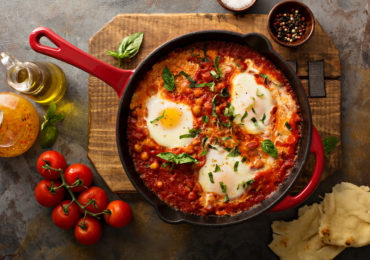
A classic breakfast dish that is served all day.
Variations of Shakshuka are common in Mediterranean cooking but the style usually on the menu in Israel is similar to that served in Tunisia.
At essence, it involves eggs poached in freshly made sauce of tomatoes seasoned with paprika, cumin, nutmeg and pepper.
Often it is prepared with onion or hot peppers and garlic. Its generally served with pita or baguette or thick bread to soak up the sauce. Many bistros bring it to the table in the hot iron skillet it was cooked in.
Meurav Yerushalmi
Delicious – but don’t tell the faint of heart what the ingredients are until they finish eating.
This dish translates to Jerusalem mixed grill and consists of cubes of lamb fat, chicken liver, spleen and other organ meats spiced with tumeric, pepper and cumin then sautéed with splashes of olive oil along with onion on a flat grill.
It can be served as the main course in a restaurant but is usually served in a pita with hummus, zhug, amba and tehina. Its origins are deeply rooted in the colorful Mahaneh Yehuda Market in Jerusalem where several locals claim to have invented it.
From its humble beginnings it soon grew in popularity and is available across Israel, sometimes just called “meurav,” Hebrew for mixed.
Kugel
Kugel is a savory casserole with potato as the star ingredient. It’s a traditional dish for Jews from Poland, Lithuania, Hungary, Romania and other European countries.
In Israel, it is usually served on the Sabbath or on special joyous religious occasions.
To taste it elsewhere you would typically have to either visit a good market like Mahaneh Yehuda, or a mom and pop eatery in an Ultra-Orthodox neighborhood where it can be bought by the slice from gigantic cakes.
A sweeter variation of this classic is called “Yerushalmi kugel,” Jerusalem kugel in English, that substitutes noodles for potato and is often seasoned with raisins and cinnamon.
Shawarma
Similar to the Greek gyro or the Turkish doner kebap, shawarma is one of the most popular street foods in Israel.
Typically made from layers of meat and fat from either chicken, turkey or lamb stacked through a big metal skewer on a rotating vertical rotisserie it is shaved off to serve as orders are made.
The vendor will likely ask if you want all the trimmings with a traditional shout out of: “Hummus, chips, salat?”
Just say yes please or “ken bevakahsa” in Hebrew. Actually, drop the please or bevakasha – come on you are in Israel!
Felafel

Israel’s national snack claimed by many in the region as their own. It’s now a vegetarian standard common around the world. But for some reason, it tastes better in Israel.
Probably due to the fresh ingredients and the attitude in which it is served and consumed.
This iconic fast food is made from deep-fried balls of ground chickpeas or fava beans seasoned with herbs and spices that are usually closely guarded secrets. Traditionally served in a pita with Israeli salad, fried eggplant, hummus, pickles, and


 English
 简体中文
简体中文 Français
 Deutsch
 עִבְרִית
 Português
 Español